Hunt the valley. Raise the city. Hold the gate.
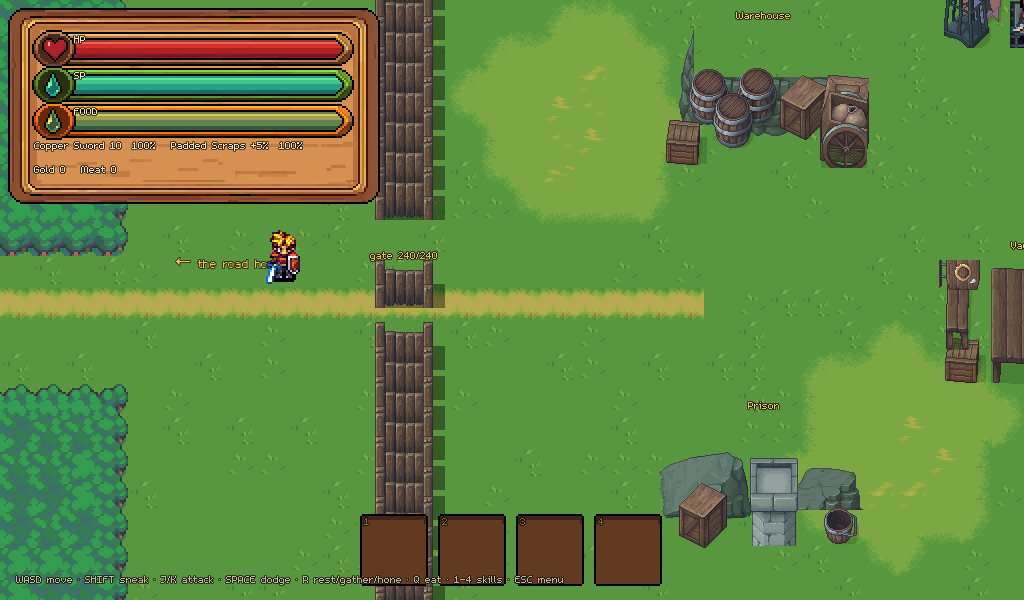
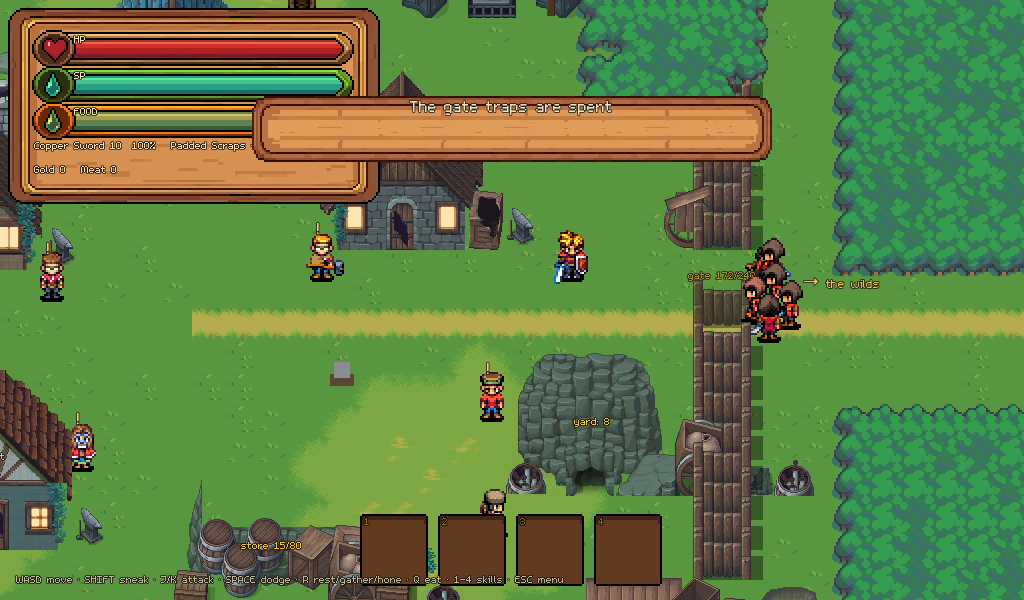
Captured straight from the v0.1.30 build: the hunting grounds, the bandit camp, the walk home through the palisade, the buildings at work, the Town Hall, and a raid settled at the gate. Open on YouTube.
No XP. No levels. Just what you carry and what you build.
Aether Shard Survival is a sibling to Aether Shard — same shattered world, same pixel soul, deliberately opposite rules. The turn-based grid is gone: combat is real-time action, and there is no experience bar anywhere. Every scrap of power comes from gear you find, craft, and maintain — and gear comes from a city you raise from nothing, staffed by people you rescue from the wilds.
Hunt animals to eat. Rest to recover — it's the only way stamina comes back. Keep your blade honed, because steel dulls and death dulls it faster. And when your city grows rich enough to be worth raiding… it will be.
In the prototype now
A living city and its hunting grounds in Godot 4 — every mechanic below is implemented, playable on a controller, and locked in by an automated test.
Real-Time Combat
Light and heavy attacks, a dodge roll with i-frames, knockback, hit-flashes — using the character sheets' long-dormant action frames the turn-based game never touched.
Rest-Only Stamina
Abilities burn stamina and nothing regenerates it but resting — crouched, vulnerable, watching the tree line. Risk management is the whole rhythm of a fight.
Hunger & Hunting
A hunger bar that always ticks down. Boars graze, flee, and charge when wounded; their meat restores hunger and health. Starve and your health follows.
Gear Is Power
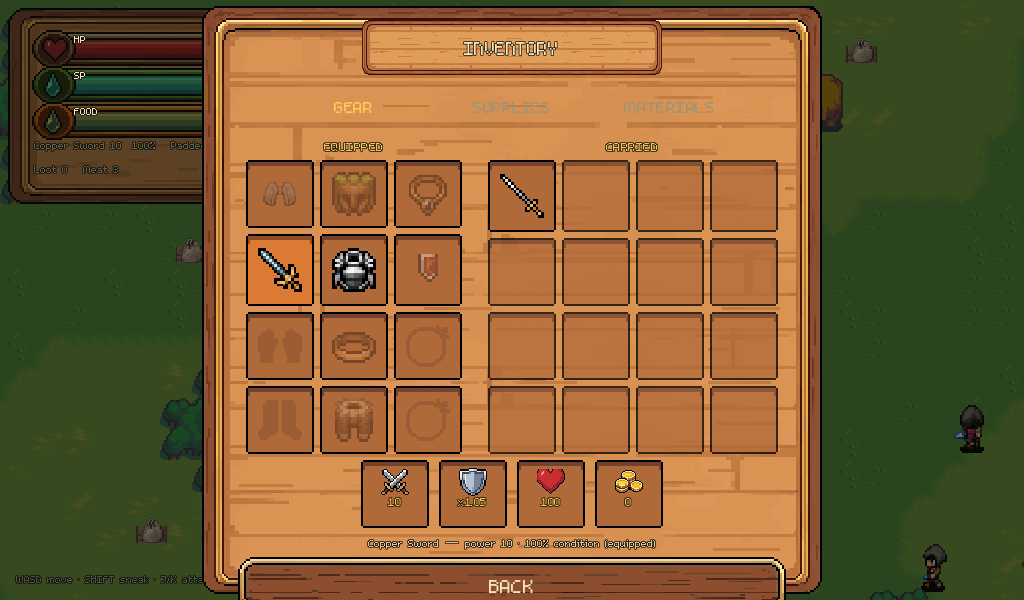
Weapon and armor slots are your only stats. Found gear swaps in a step — and your old piece drops where you stand, condition and all.
Dulling, Never Breaking
Blades wear with every swing, armor wears with every hit, death dulls everything — but gear is never destroyed. Hone it at the whetstone and get back out there.
Tomes & Loadouts
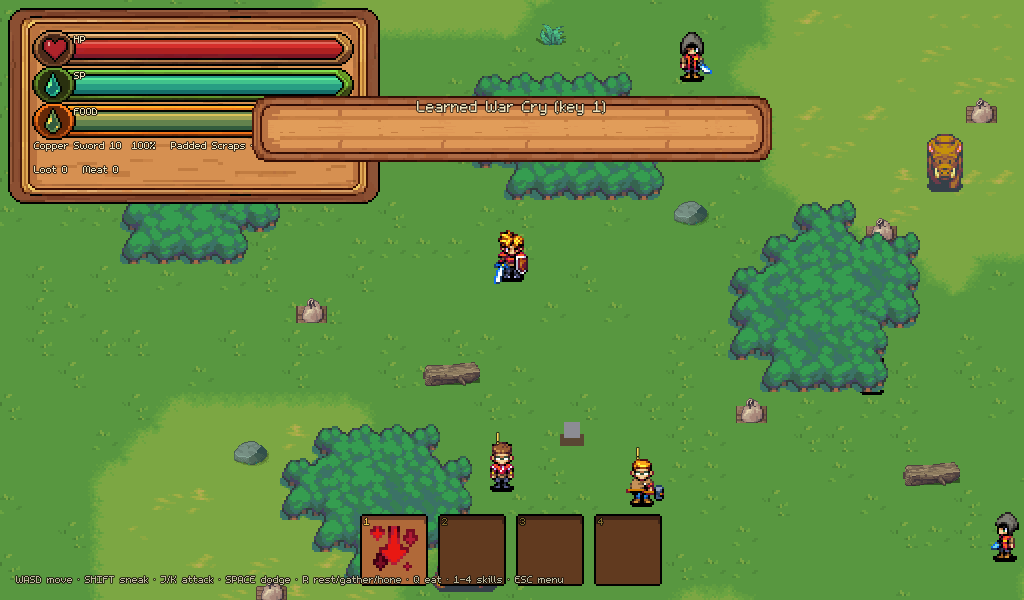
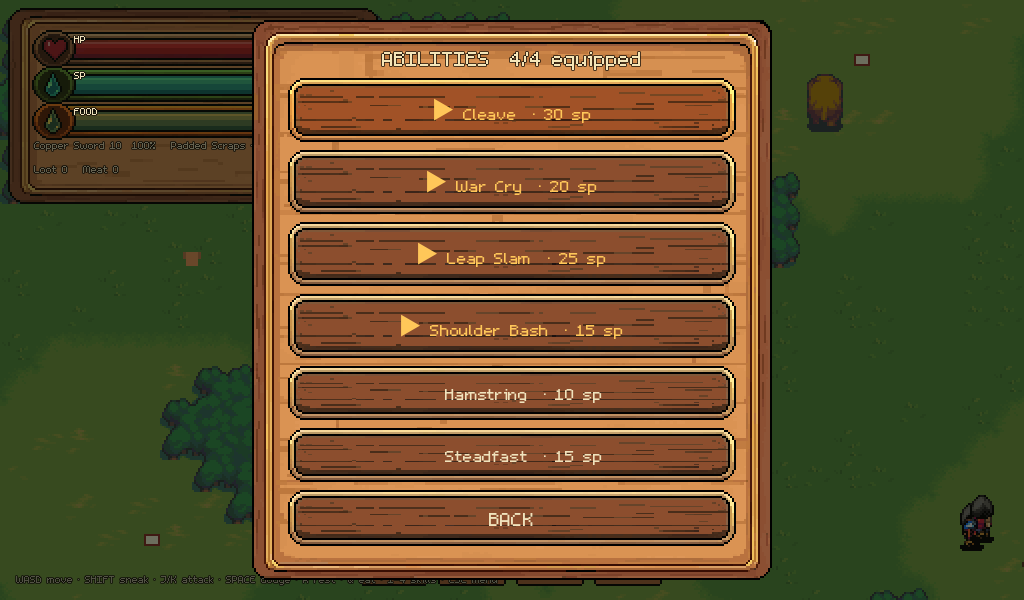
Abilities are loot, not level-ups: six tomes in the field — Cleave, War Cry, Leap Slam, Shoulder Bash, Hamstring, Steadfast — and a strict 4-slot loadout you swap in the pause menu. Play it your way.
Controller & Touch
Built for iOS, Android, Steam, and handheld Linux: full gamepad support (d-pad = your four skills) and a multi-touch overlay with a floating stick. Same hero, any screen.
The Quiet Way In
Two sentries walk the inside of Ironhold's wall with the same eyes as every bandit. A grappling hook at the marked spot takes you over without a sound; lockpicks open the vault and the prison; you carry what fits in the bag and one rescued prisoner — no cart. Get seen and the bell rings: fail-forward into a siege you didn't provision for. Leave without the hall and no Heat follows you.
Raiding Back — Ironhold
The first rival city: your city seen from the road, rebuilt on the clock while you're away. Breach the gate with the Engineer's charges, weather the garrison's waves, empty the warehouse into a haul cart, take the vault, free the prisoner, and fell the champion for their Keen sword. Then choose: Loot or Cripple. Heat follows you home as a retaliation raid sized by what you did.
The Scribe — The Last Building
Two skills exist only as damaged tomes in the wilds — Second Wind (the one skill that gives stamina back) and Whirlwind. Aldous's Scriptorium restores them into readable tomes; a Restoration Desk halves the work; the Athenaeum fuses loose fragments from the bandits' hoard into a tome of a school you choose — targeted skill acquisition. All nineteen designed buildings now stand.
The Enchanter — Bound, Not Borrowed
Era 4. Every other raider carries raw essence and spills it when killed; Wyn's forge refines it, and essence plus gold binds an enchant to the piece you're wearing: Keen (+12% power), Warding (+12% protection, taught), Hungry (every kill mends). Unlike a gem, an enchant stays with the piece — choose what you mean to keep. The Disenchant Font grinds spare gear back into essence.
The Engineer — Teeth for the Wall
Tovik makes fittings, and with them the raid profession's first goods: spike traps you set at the gate (they bite every raider standing there), a ballista on the palisade that fires on its own during a raid, and the smoke bomb — everyone nearby loses you, the sneak path's first gadget. Automated defenses fight; you are still the strongest piece.
The Jewelcrafter — Gems That Travel
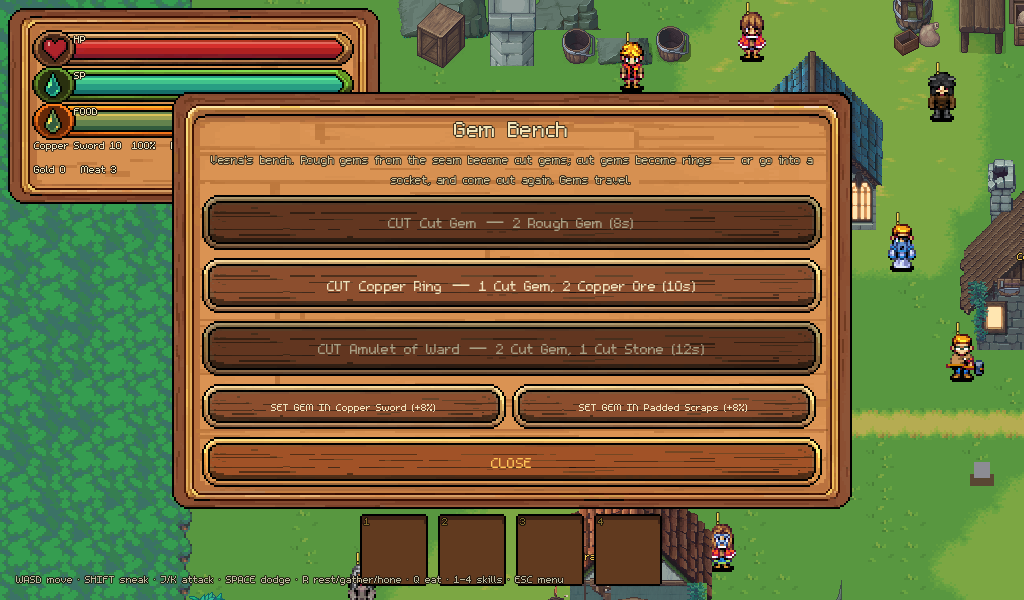
The only Era-3 building. A Gem Seam on the mine yields rough gems; Vesna cuts them (a Cutting Wheel cuts two) and sets them: a Copper Ring (+5% power) and an Amulet of Ward (+6% protection) fill the doll's ring and necklace slots and never wear. The Setting Kit opens sockets: a gem in your weapon or armor is +8%, it stays with that piece when you swap — and you can pry it out and move it. The layer that carries between gear tiers.
The Fishery — and Era 3
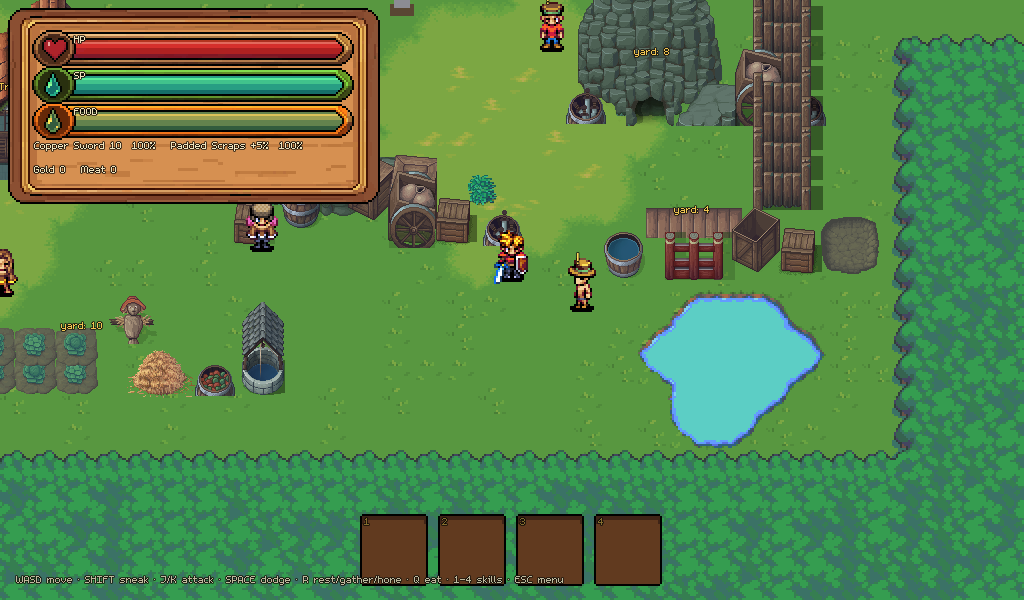
The valley has water now: a still pond in the south-east corner, the first change to the ground since the road. Tarn's dock pulls fish off the lines on its own; a Net Loft from Brida's cloth speeds the catch, and a Smokehouse turns fish into rations that keep. His First Catch teaches Marla the Fish Stew. With the dock standing, every Era-2 building exists — the Town Hall can charter Era 3.
The Mill
The Farm grows grain now; Osk grinds it to flour and, with a Bakehouse, bakes bread — food on its own and the staple under Marla's best meal. His First Grind quest teaches the Shepherd's Pie: bread, meat and greens, three ingredient types, +8% power for five minutes. A Grain Lift makes every grind two.
The Weaver
Cloth comes off Brida's loom on its own. She sews a Quilted Coat to order, a Dye Vat opens the finer Dyed Cloak, and the Tannery turns boar hides (boars drop them now) into leather for the Leather Jerkin — the first armor ladder you make instead of find: 15%, 22%, 30% protection.
The Herbalist & the Alchemist
Nell's garden grows bitterleaf into its yard; Seed Beds add sunroot, the second herb. Ysolde brews healing potions from them, a Still doubles every brew, and two quests teach the Stamina Draught (the only thing besides rest that refills stamina) and the Ironbark Tonic: 15% less damage for two minutes — the potion buff layer, which stacks with your meal exactly as the design promised.
The Mason's Yard & the Palisade
The first Era-2 building — a plot you can see but can't raise until the Town Hall charters the era. Gerd quarries stone and cuts blocks to order, and his yard raises the Palisade: a wall of stakes across the east side with a 240-point gate. Raiders must break it before they touch the road. Repair it for timber; a Watchtower on the wall (needs the Mortar Shed) adds twenty seconds' warning. Away when a raid lands? With the gate up you lose a tenth, not a fifth, and nothing gets wrecked.
Raids
Earned, never random: a stocked Storehouse and a Town Hall to show it off start the clock, and every building you raise shortens it. Telegraphed: thirty seconds' warning (the Chapel's Bell Tower or a Marshal mayor buy more). Raiders come up the east road for the store, grab three goods each and run — kill a carrier and the sack spills. An empty store gets wrecked instead: offline until repaired for half the cost. Away when it lands? A fifth of the store and one wrecked building. Never erased.
Save & Resume
The whole game is two dictionaries and a position, so it saves as one JSON file: every 20 seconds, at every gate, on death, and whenever the app loses focus. Close the app in the wilds and you wake up in the wilds. Death keeps its price — dulled gear persists and you rise at half health. NEW GAME in the pause menu wipes it.
The Town Hall, the Mayor & the Charter
The city's ledger, a Notice Board of faceless bounties, and a Mayor's Office: appoint any recruit and the city takes on their governance style — Steward, Builder, Merchant, Loremaster, Shepherd — scaled by their quality. Once every Era-1 building stands, the hall charters Era 2 for a fee, and iron reaches the Trading Post.
The Farm
Tamsin's field grows greens into the yard; a Chicken Coop adds a bird to every harvest — the second food type. A Well brings harvests around faster, and her Hen House quest teaches Marla the Farm Supper: a longer, milder food buff.
The Storehouse & Haulers
The city's own stockpile. Buildings draw materials from it as well as your bag, and its capacity is the economy's ceiling. Break the bandit camp and a captive follows you home — assign her as a hauler and the yards empty themselves while you're away.
The Lumber Camp
Hollis fells old growth at the valley's edge and timber stacks in the yard. A Sawpit squares an extra length per haul; a Charcoal Kiln adds a second product — fuel for hotter forges later, coin now.
The Mine
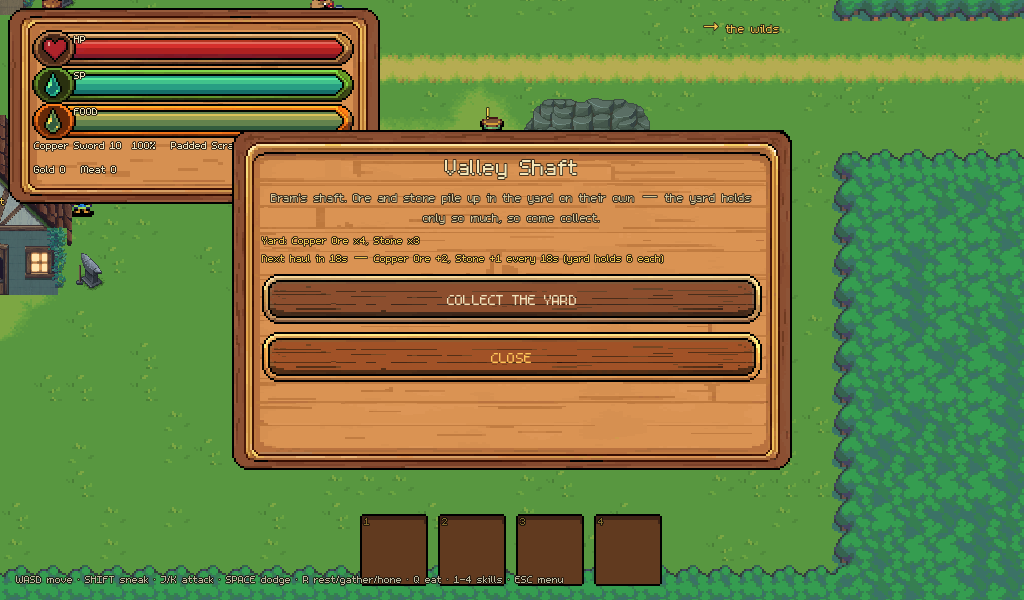
The first producer: Bram works the copper seam while you're away and ore and stone pile up in the yard. The yard holds only so much — that cap is what calls you home. Cart Rails haul more often; the Lamp Room digs deeper.
The Trading Post
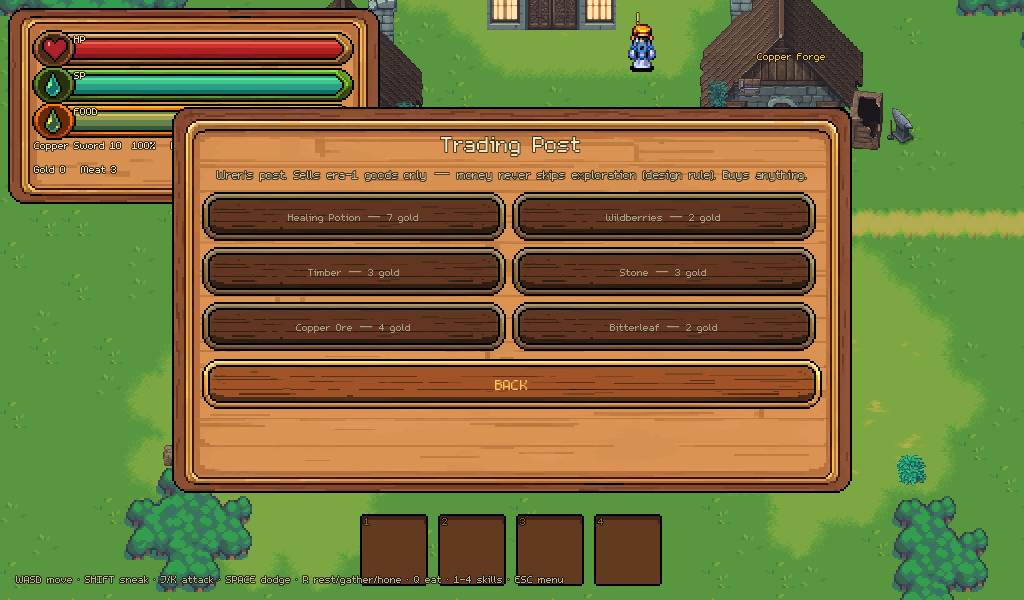
Wren buys anything you haul and sells the valley's goods — and never anything above your era. Money can't skip exploration. Add a Ledger Desk for better prices both ways.
The Chapel & Your Calling
Ansel's shrine mends you — and ordains you. Six callings, each one passive on a real mechanic: Berserker, Warlord, Templar, Aethermancer, Trickster, Ranger. Change your mind at the Reliquary, for a fee that grows with distance around the ring.
The Town
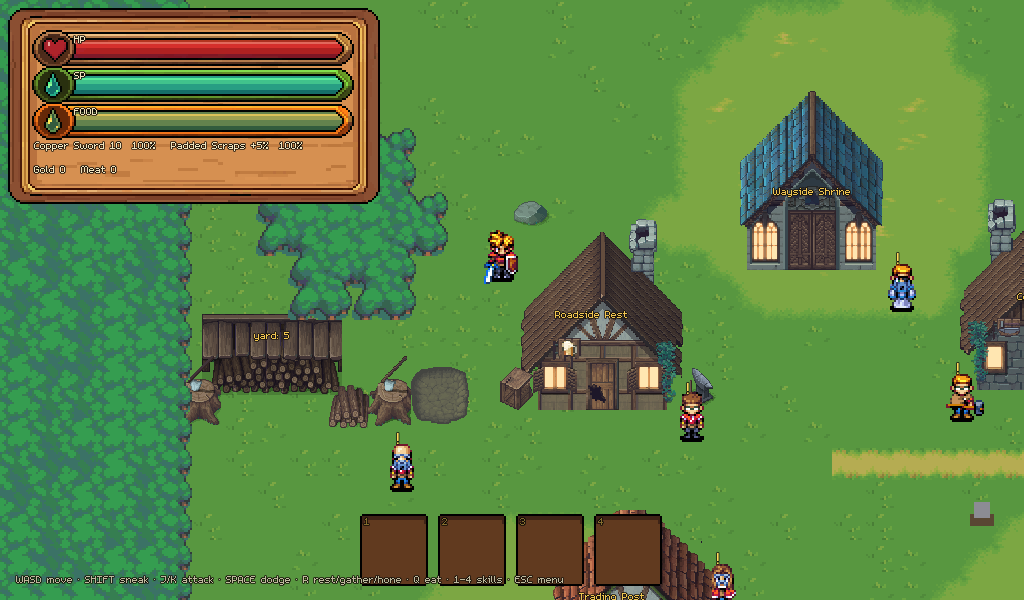
The city site is its own place now: authored plots, your recruits, the whetstone, and a road east into the wilds. The city is data — buildings keep working while you're out hunting, and the same record is tomorrow's save file, friend snapshot, and raid target.
The Roadside Rest
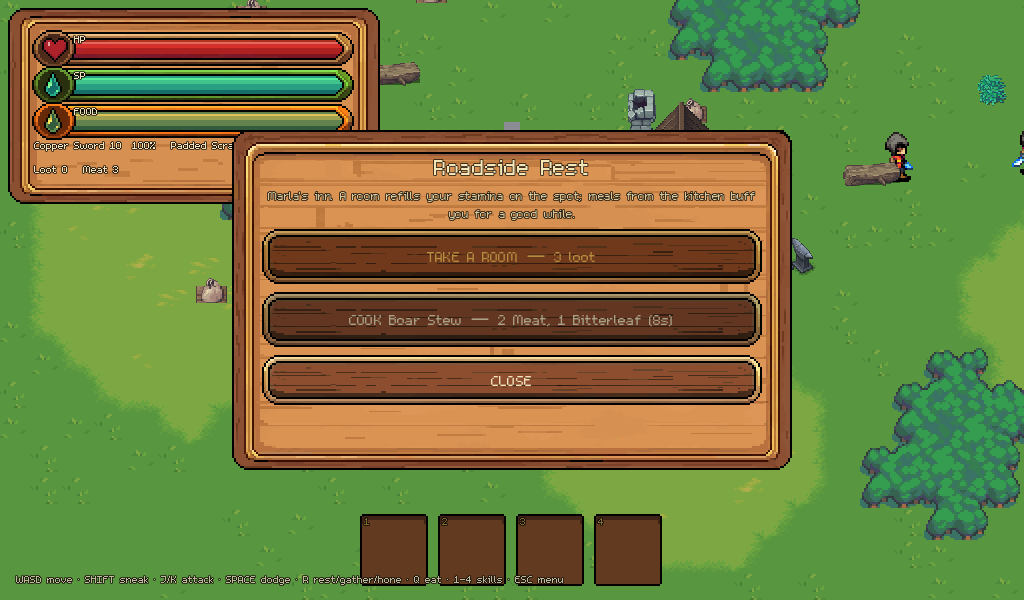
Marla's inn: take a room and your stamina refills on the spot. Add a Kitchen and she cooks Boar Stew — the first food buff, +10% power for two minutes. The compounding layers begin.
The First Building
An empty plot beside Orrin becomes the Copper Forge for six timber, four stone, and twenty seconds of work. Then repairs, craft orders that finish while you're out, a Grindstone module that cheapens repairs and unlocks Q2 work — and recipes Orrin only teaches once you've earned them.
Gathering
Deadfall, stone piles, a copper vein past the bandit camp, herbs and berries. Hold R in reach to work a node — one material a second until it's spent and regrows. The economy's first inputs.
NPC Quests
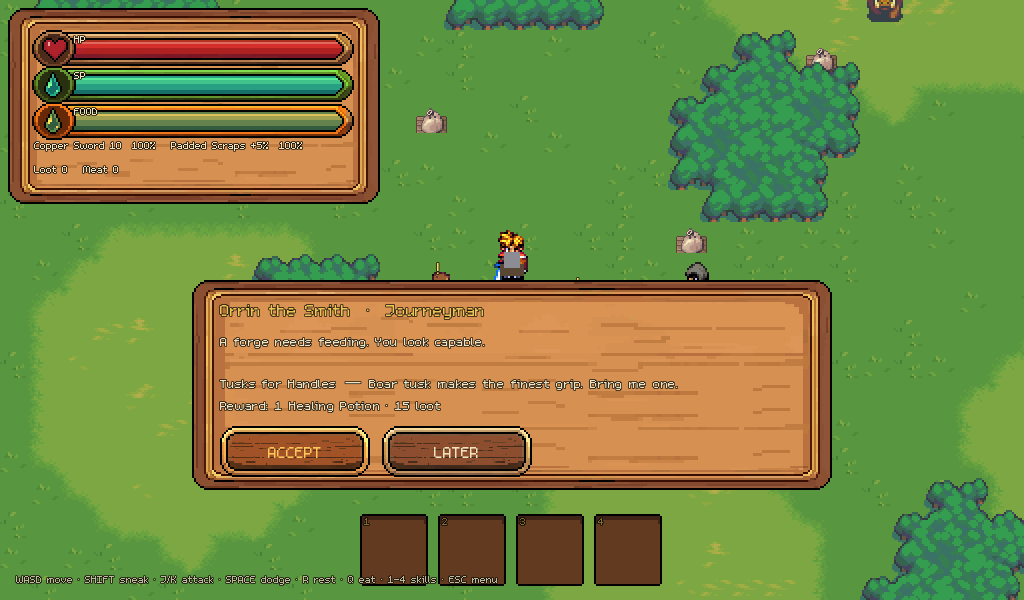
Your first recruits — an innkeeper and a smith — post errands in character: hunt boars, bring meat, break the camp. Better-quality recruits pay better. The survival loops finally have owners.
The Overworld Look
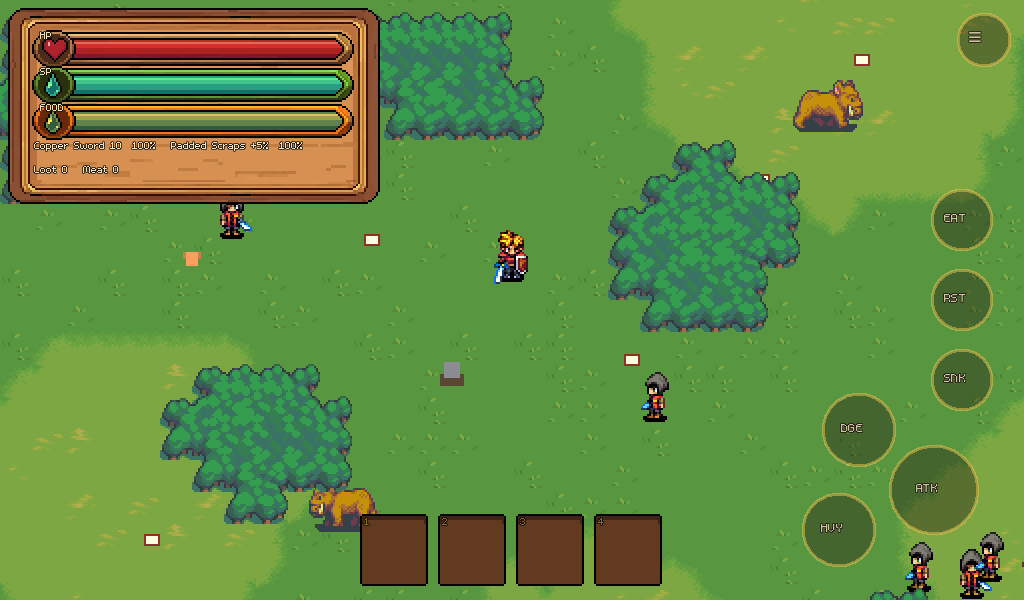
The same Wonderdot tileset and UiKit interface as Aether Shard proper — grass, meadows, tree canopy, wood-panel HUD, and a pause menu straight from the mothership.
The Bandit Camp
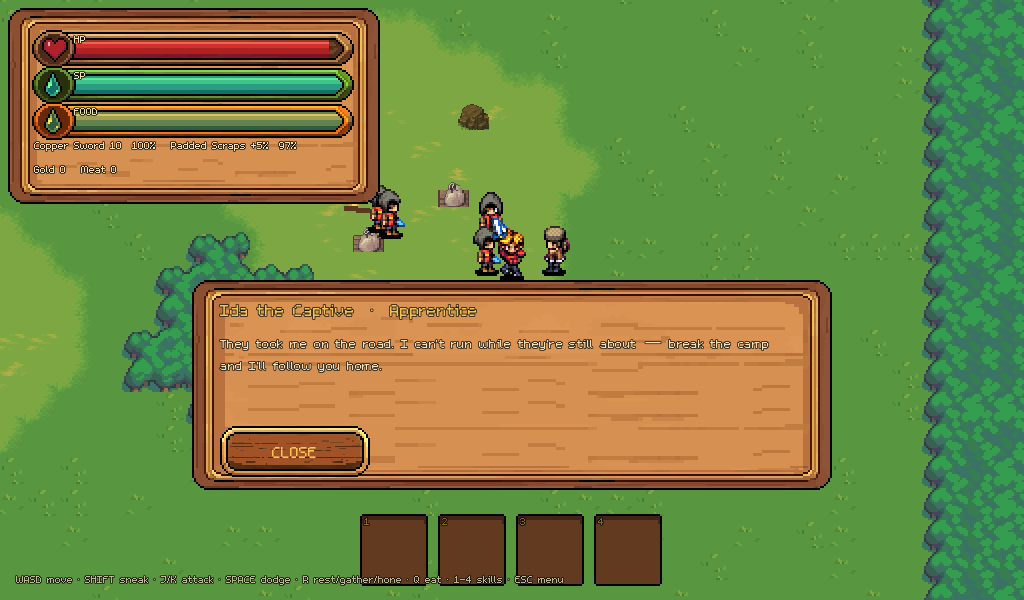
Four guards around a fire with shared aggro — wake one, wake the camp — holding the arena's best gear. The first micro-raid: go loud, or…
Stealth
Crouch-walk and enemy perception collapses — a sliver behind their backs. Sneak strikes hit double. Slip past the camp, or dismantle it one silent blow at a time.
A Tuning Model
An 800-formula balance workbook drives the numbers: gear curves, enemy stats, building costs — tuned so total power triples every era. The prototype matches it.
The game it becomes
Every system below is fully designed and cross-linked in the project wiki, waiting its turn to be built.
A City From Nothing
All 19 building shells stand — blacksmith to enchanter, inn to town hall — each with modules and quest-taught recipes, gated by four chartered eras. Still ahead: the full tier ladders (Journeyman and Master upgrades) and the Master-tier modules.
People Are Loot
Professions belong to the city, not a skill bar. Recruits found and rescued in the world run your buildings — and a Master blacksmith is a legendary drop. Building tier × artisan quality = what you can make.
The Mayor Is Your City's Class
Six governance styles, each favoring a pillar — production, defense, trade, construction, lore, people. Appoint any recruit and the city takes their style at their quality. Built. Still ahead: edicts, the mayor's togglable policies.
Morale
One city-wide mood — anchor plus shocks, five bands from Grim to Jubilant. A modifier, never a gate, with hard anti-death-spiral rules. Feed your people three ingredient types and watch the town sing.
Raiding Back
Offense is in with Ironhold: siege path, haul cart, champion, the Loot / Cripple dial, Heat and retaliation, a rebuild clock. Still ahead: Raze, kidnaps of your people, the war party met on the road, more cities in more wedges — the design.
A World That Opens As You Build
A home valley and four era wedges, each behind a collapsed bridge or buried pass. Opening a zone is a city project — and an open road lets the raiders through, both ways.
Compounding Power
Enchants bound to gear, gems that travel between pieces, stacking food and potion buffs, trinket slots — all in play. Still ahead: imbues, the second enchant layer, and the gear grid's higher eras.
Tomes Worth Restoring
Tomes loot in damaged; the Scribe restores them, and the Athenaeum fuses fragments into the skill you choose. Built. Still ahead: more schools' tomes, so every calling has a reason to look.
An Honest Economy
The Trading Post never sells above your era — money can't skip exploration; every charter adds a shelf. Built. Still ahead: the Alchemist's transmutation basin (down-convert, never up) and caravans.
The class hexagon
Gear owns your stats; class owns your kit. Live in the prototype since v0.1.15: ordain at the shrine, respec at the Reliquary with a fee that scales with how far around the ring you jump. Every passive touches a different pillar of the game — and every one is a real number in the build.
Berserker
Might + Wildcraft. Two-handed fury that burns hotter as stamina runs low. The pure combat passive.
Warlord
Might + Bulwark. The quartermaster — gear dulls slower, repairs cost less. Economy as a weapon.
Templar
Bulwark + Devotion. Warden of the Wall: stronger inside your own city during raids. The defender.
Aethermancer
Devotion + Aether. Attuned — enchants run stronger, essences fall more often. The enchanting engine.
Trickster
Aether + Subterfuge. Light-fingered: stealth gadgets cost less, detection climbs slower. The infiltrator.
Ranger
Subterfuge + Wildcraft. The provider — more from every kill, faster on roads, a nose for rare wanderers.
Prototype screenshots
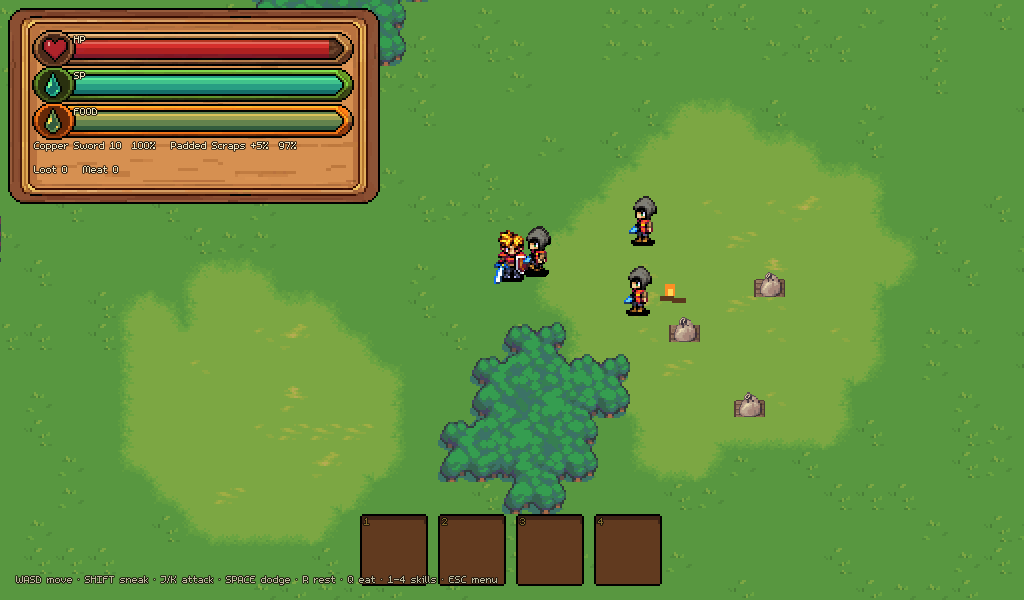
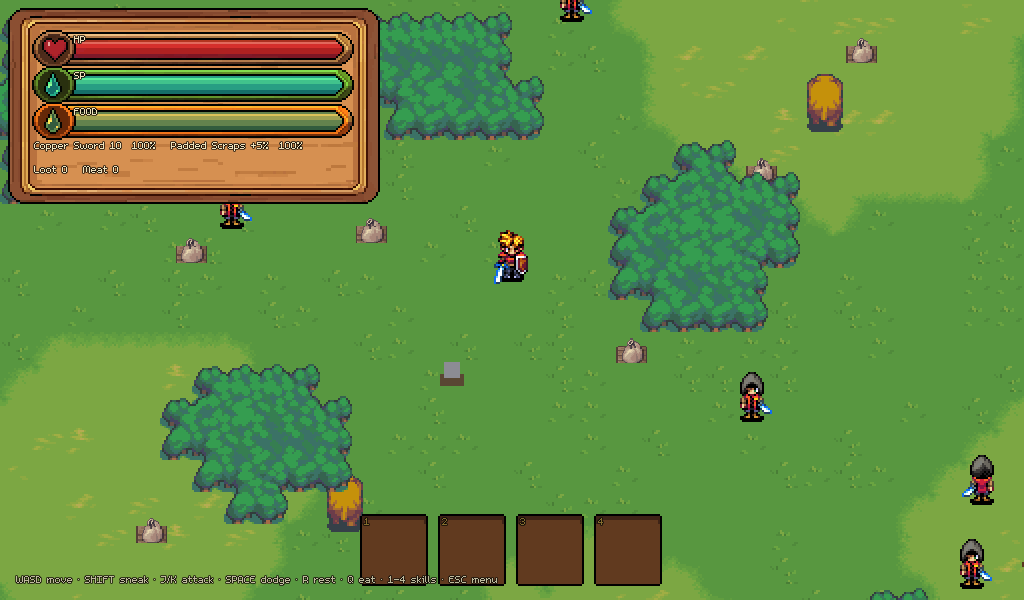
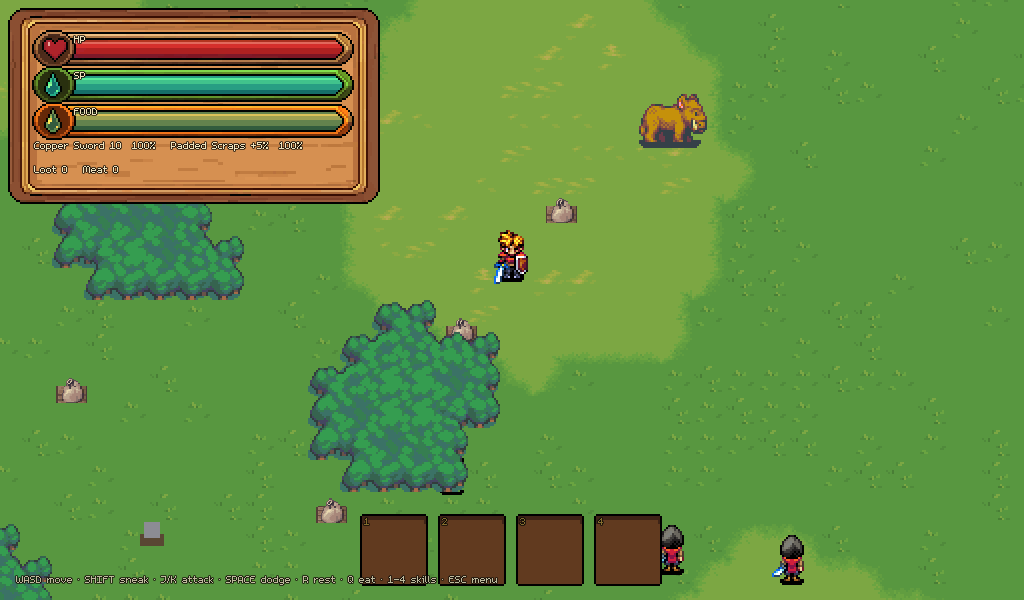
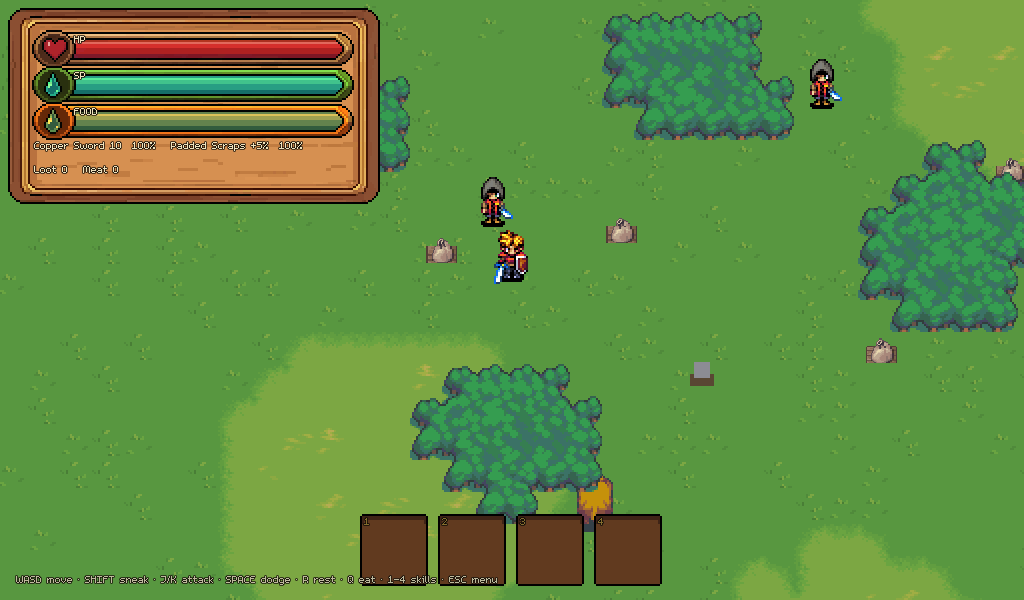
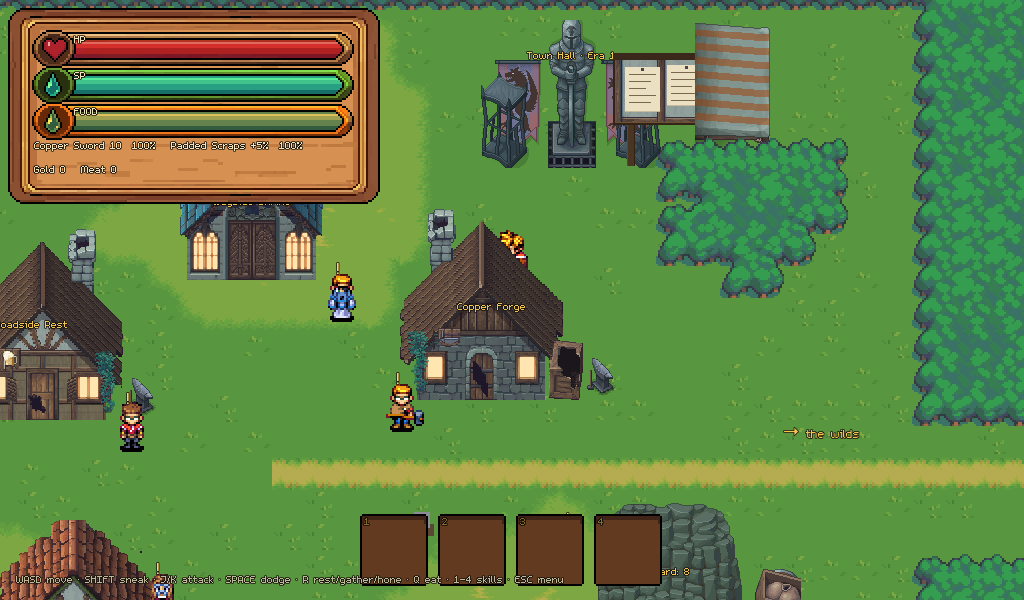
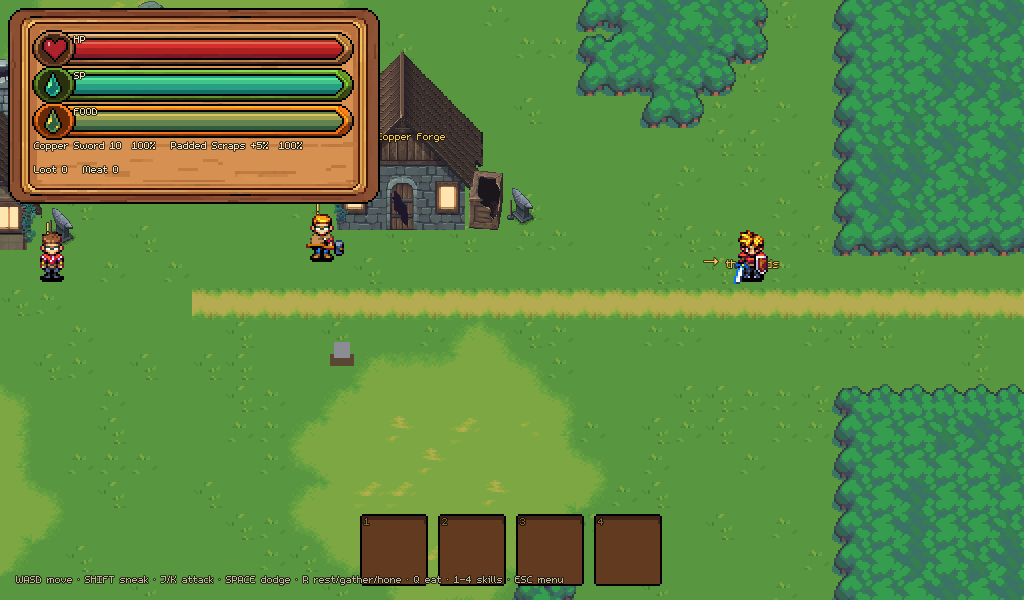
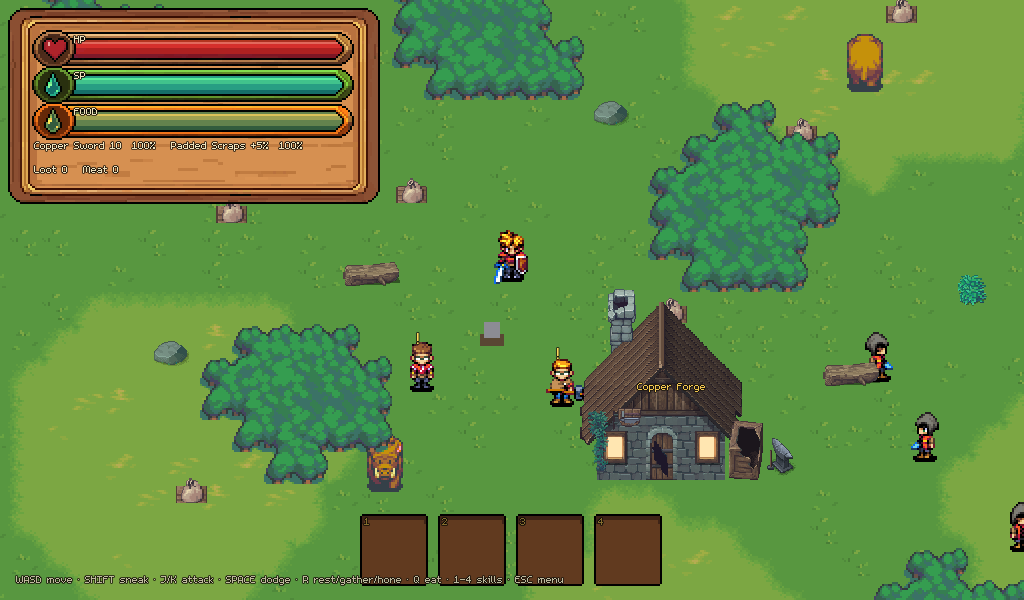
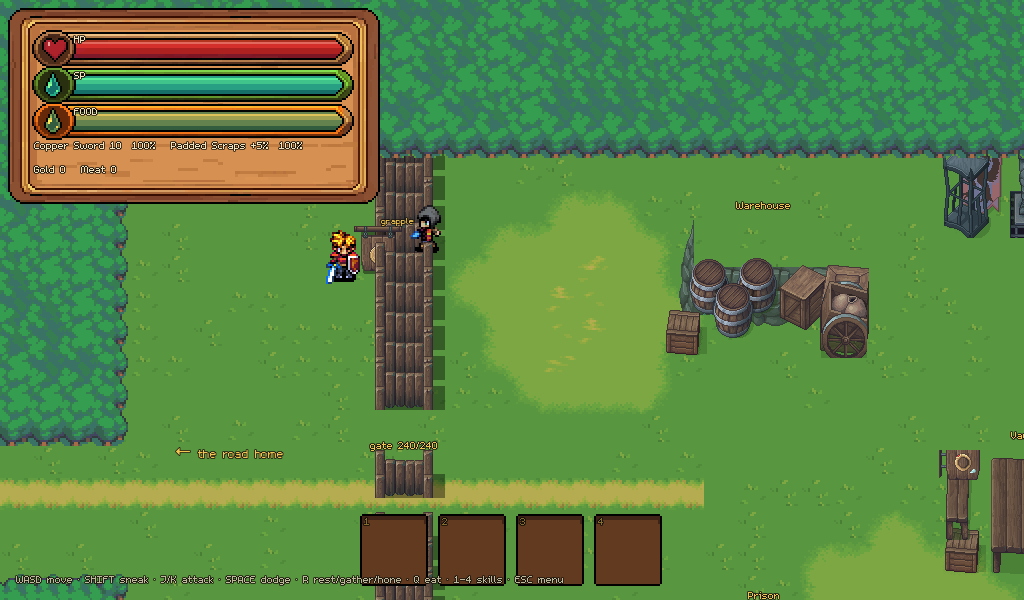
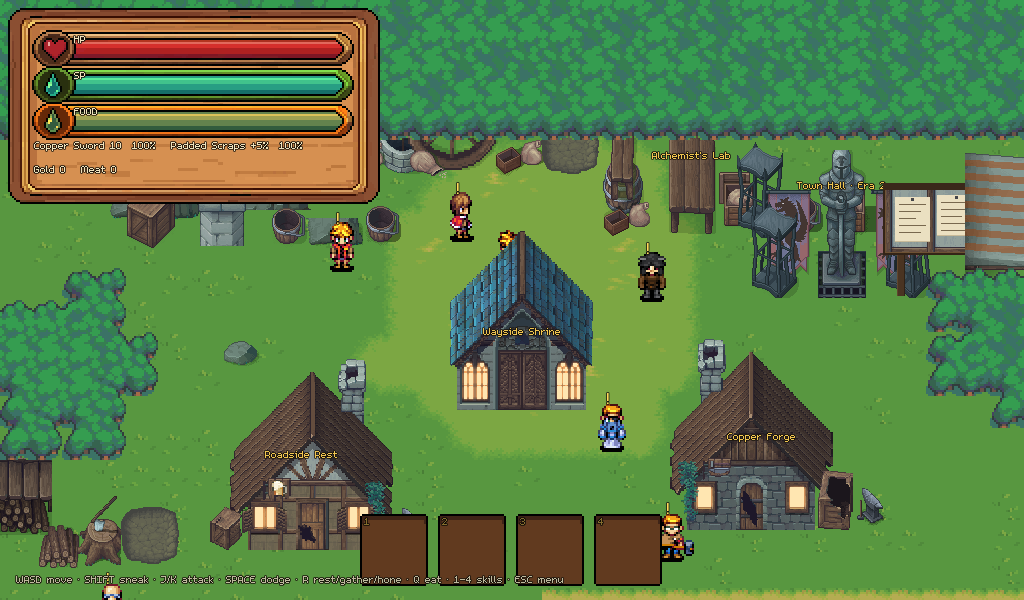
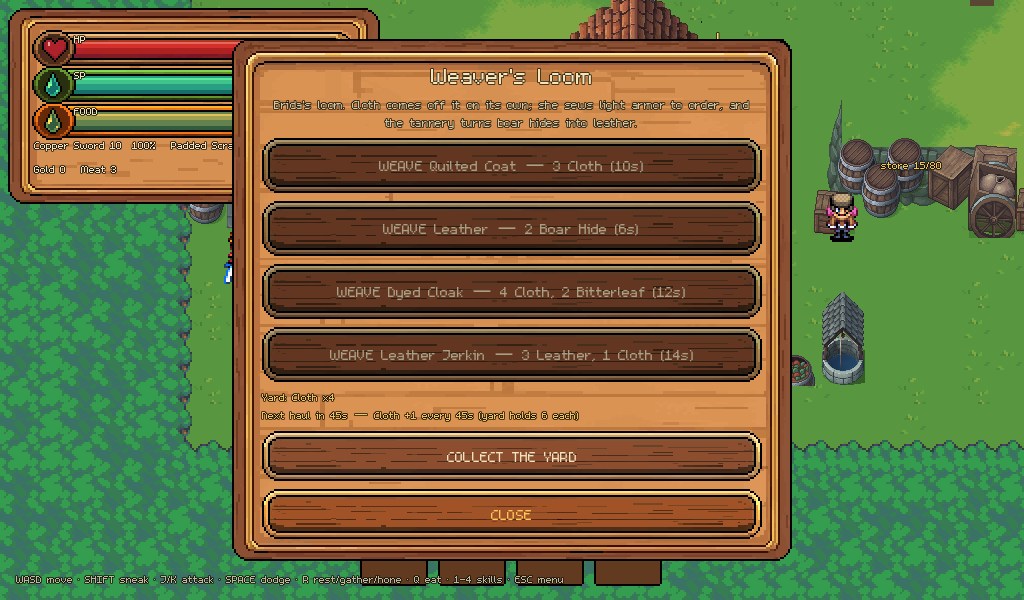
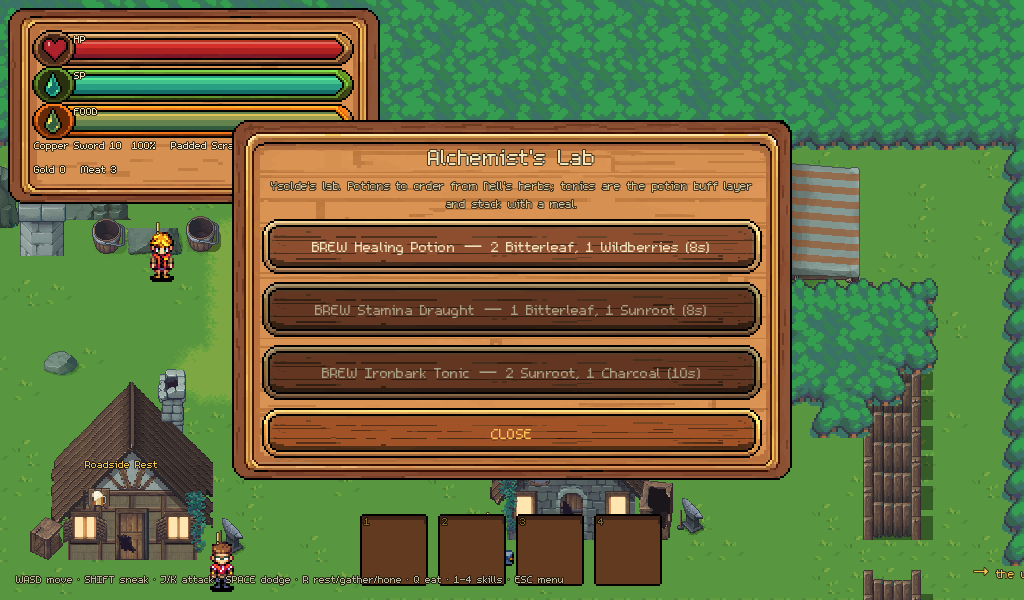
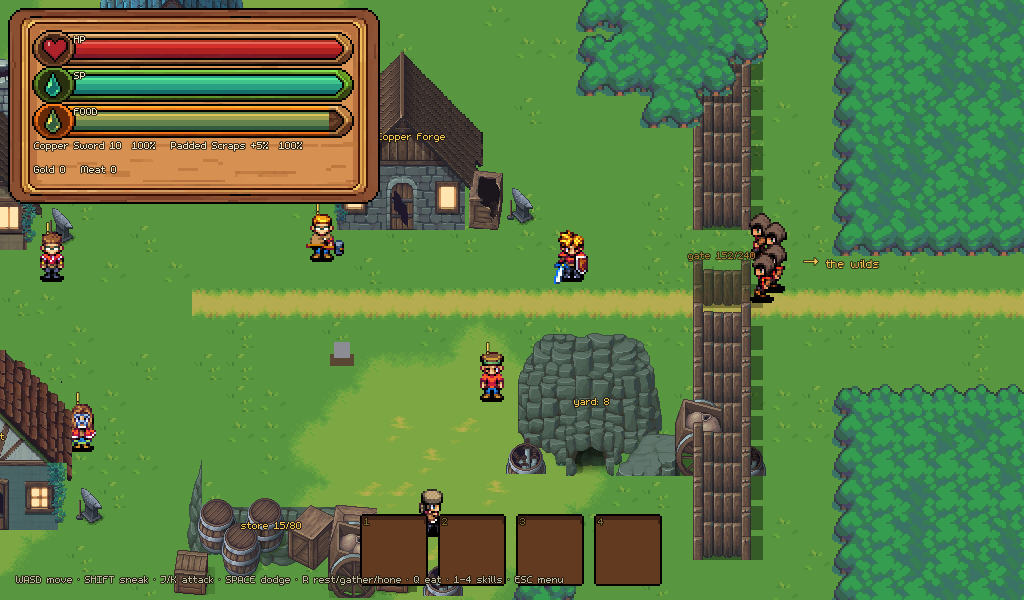
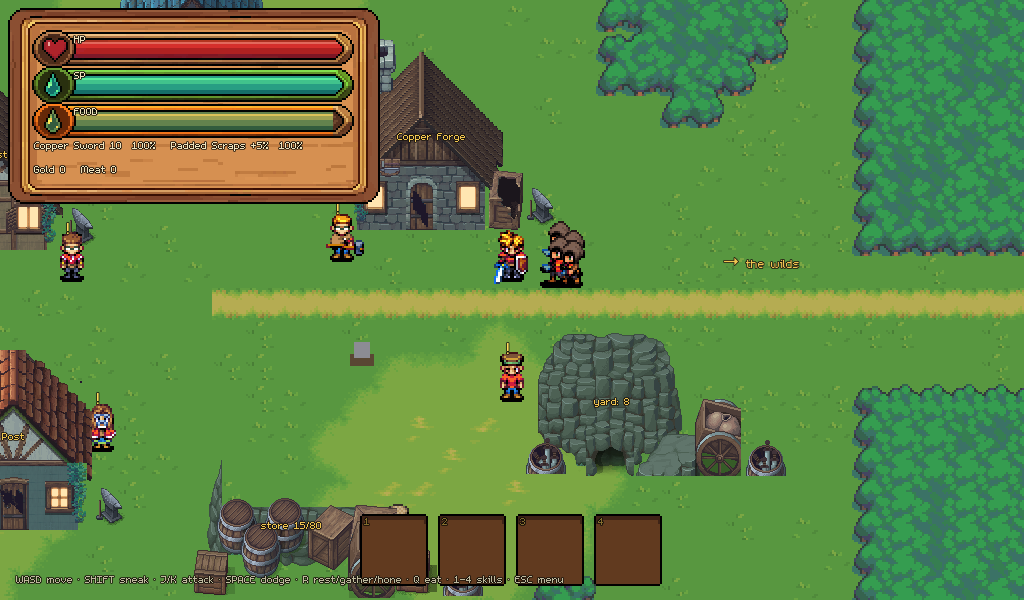
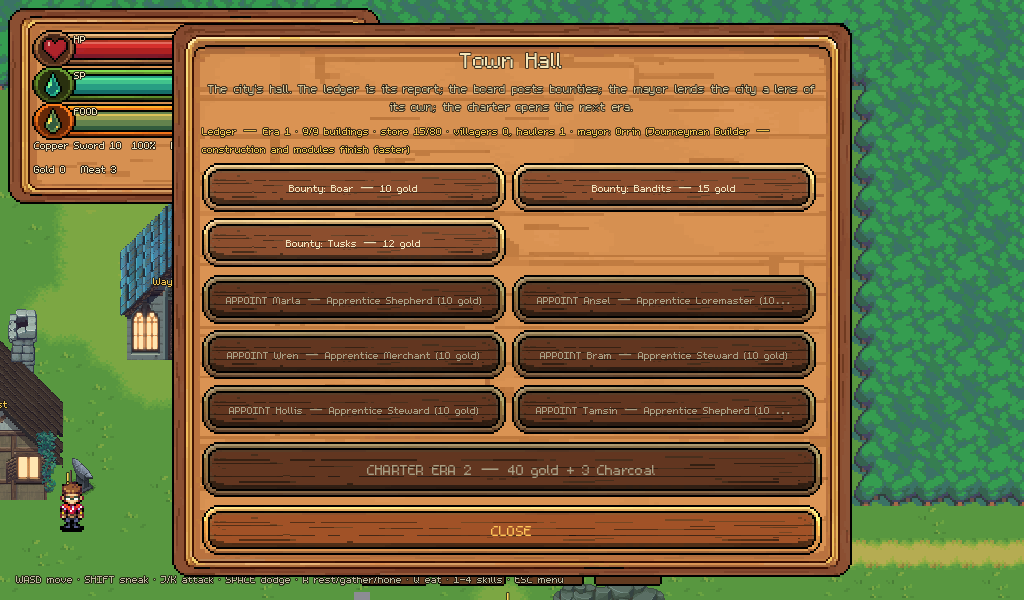
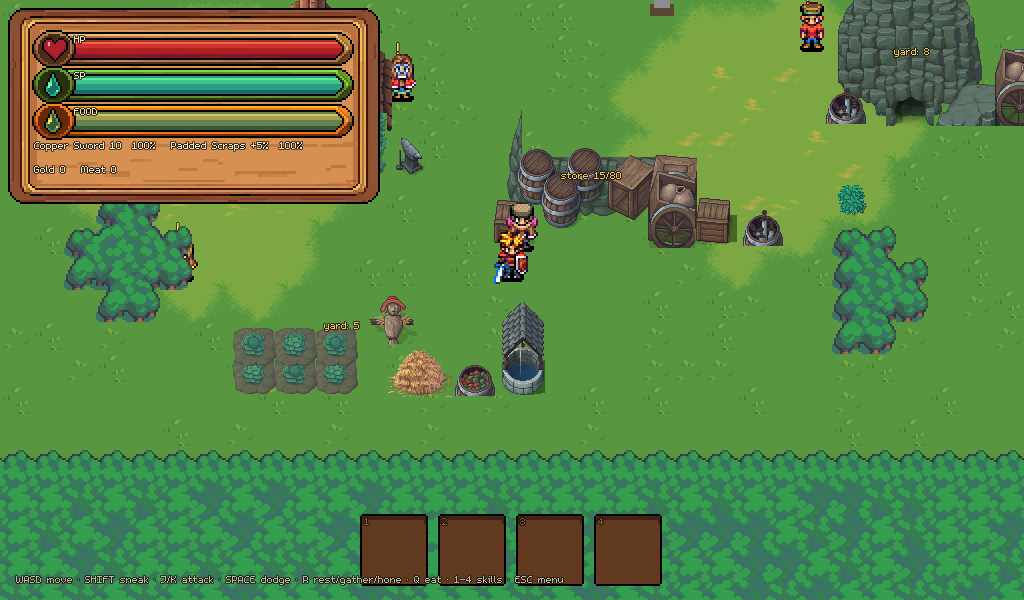
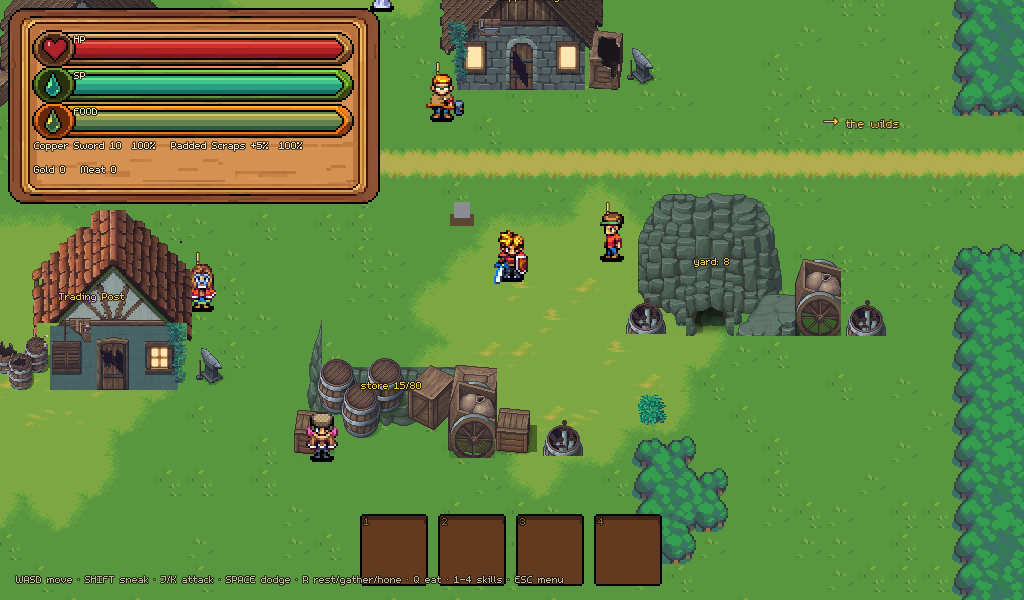
Devlog
Encampments you phase into
- A continent, not a bowl (v0.1.76): the overworld is Aether Shard's scale now — 640 by 480 tiles of land running east to a sea, with mountain ranges and passes, hills, forests, meadows, rivers to the coast, and mist only where the world ends in the far west and north. Home sits inland in the west, Ironhold by the eastern sea, the camps and ruins spread across the land with trails to each, and three cave mouths wait in the ranges for later. Walk onto a town to enter it, as before; everything between is one unbroken map.
- The bandit camp is a site (v0.1.38): one lit fire on the wilds road with a name and a live guard count, where four campers, a hoard and a captive used to sprawl across the map. Walk onto it and you phase into the camp — the Ironhold pattern shrunk to a clearing, rendered from a record the world keeps.
- Inside: two guards at the fire and two sentries walking the edge on one shared alarm (sneak past, or backstab one before he wakes the circle), a chief by the tents (60 hp, hits for 12, drops potions and essence), the hoard sack (the iron sword, a potion, two tome fragments), and a caged captive who follows you home once nobody is left standing. Out the west road and you're back beside the site.
- Breaking it turns the site to ashes with a countdown; guards, chief, hoard and a new captive regrow in eight minutes on the world clock. The record rides in the save. The wilds keep only lone wanderers and animals now.
- Black screen fixed (v0.1.73): the valley's map file wasn't being packed into the Android and PortMaster builds since v0.1.66, so a new game opened on an empty, misted world. The exports include it now, and the deploy refuses to ship a build without it.
- Titles off the frame (v0.1.72): every menu page now starts below the panel's carved border — no title or tab row sits on the wood — and the map, gear and controls pages fit without scrolling.
- Menu text stays inside its panel (v0.1.71): every pause page lives in a scroll frame now, so nothing runs off the bottom and BACK is always reachable; captions grow instead of being cut; quest dialogs size themselves to their text; the ABILITIES board fits one screen with the diamond on the left and the two pools beside it.
- Skills laid out like the d-pad (v0.1.70): the ABILITIES screen now sets your four skills in a diamond — top is up, right is right, bottom is down, left is left — and on a controller the skill bar in play sits the same way. Keyboard and touch keep the row.
- The ruins have a purpose (v0.1.69): the two old keeps in the far valley are squatted now — three squatters and a chief each, the old builders' hoard (tome fragments, cut stone, a potion, gold) under them, and a keeper held in each: Nell the herbalist at the Old Watchtower, Hesk the drillmaster at the Broken Keep. The inn no longer brings those two; you go and get them. Walk up to the keep's door to phase in. Rare spawns too: once in a while a patch of the valley rolls a wandering champion (a prize sack when they fall), a boar herd on a meadow, or a pedlar's cart gone off the road with its goods still in the sack.
- The valley comes alive (v0.1.68): bandits, boars and deposits now come with the map, Aether Shard style — rolled fresh from the terrain as each patch of the valley streams in (forests hide bandits, meadows carry boars, hills hold stone and copper) and gone again with it. Nothing spawns on the roads or in the calm ring around home, and a bandit already on your heels keeps coming. The fixed camps, tomes and sacks are still where they were.
- The Town Hall, furnished (v0.1.67): the hall's room has its two working spots now — the city ledger on the dais (the hall's whole page: ledger, appointment, charter, modules) and the notice board by the west wall, which opens the bounties alone. Walk in, read the board, take a bounty, claim it there when it's done.
- The valley, the Aether Shard way (v0.1.66): the wilds are now one streamed valley — 512 tiles across, walled by mountains that fade into mist, with forests you walk under, hills, meadows, a river with a bridge on the road, ruins, and the four camps far apart along the trails. It runs on Aether Shard's own world engine and its Aether Sight mist: what you've seen stays lit, softly, and the map paints it. Walk into the home cell or Ironhold's to enter them. Also: the town is half again as big; the haul cart follows you home from Ironhold instead of vanishing at the gate; your bars stay in view over the pause menu; and closing a menu no longer swings your sword.
- Map on the quick button (v0.1.65): TAB, the pad's BACK button and the touch button by the menu now open the valley map; quests moved to M and the pause menu.
- Go inside, and a map (v0.1.64): a built inn, forge, post, chapel, loom, mill, dock, hall or workshop is a place you walk INTO now, Aether Shard style — the same winlu rooms, the keeper behind their counter, the door at the bottom to step back out. Talk at the counter for the building's whole page, with TALK TO them on top for quests. Yards, fields, the mine and the store are still worked from outside. The pause menu (and M) opens THE VALLEY: everything the fog has shown you, painted from your own steps, with home, Ironhold, the camps you've found and you. Game messages now land in the middle of the screen.
- A vast valley under fog (v0.1.63): the wilds are now about 150 tiles across — the home road runs the whole west half, Ironhold's road leaves the far east, the four camps sit far apart with meadows, ponds, copses and twenty-one deposits between them, and eight bandits and six boars roam it. A fog of war hides it all until you walk near; what you've seen stays seen and rides in the save. Camps and Ironhold are still places you phase into. And keepers now work inside their building once it stands: the building carries their quest marker, and TALK TO them from its door.
- Less text, harder bandits (v0.1.62): building names and yard counts only appear on the building you're about to open; camp signs only when you're near; gate health only when the gate is hurt. The control hints leave after the first twenty seconds (they live on the CONTROLS page), the quest tracker is one line, toasts are shorter and gathering just says +1 Timber. And spamming light attacks no longer stun-locks an enemy: a bandit already winding up or lunging finishes the stab through your hits — only a heavy swing, a skill or a status interrupts. Boars charge through cuts the same way.
- Strict recruitment (v0.1.61): the Inn brings only the five keepers found nowhere else (Nell, Brida, Osk, Tarn, Hesk). People held in a camp are found there, and Ironhold's prisoners only in Ironhold. One softener: once a camp has been broken at least once, the Inn may bring the keeper it held, in case the rescue was missed.
- The player is the founder (v0.1.60): no founders at all now. A new game opens on the home road with two bandits marching Marla off — free her and she is your first recruit, and she hands you the town's first quest: Find the Others. Orrin the smith is the bandit camp's prisoner, Bram moved up to Wolfhead, Ansel keeps a wayside stone in the woods and comes down if you ask, Wren is first in Ironhold's cells, and the Inn brings whoever is left. The town site starts empty, and you fill it.
- Recruitment is loot (v0.1.59): the town no longer starts with all eighteen townsfolk. Three founders — Marla, Orrin and Ansel — are there on day one. The rest you find: the four camps each hold an Era-1 keeper captive (Bram, Wren, Tamsin, Hollis — break the camp and they come home to run their shop), and Ironhold's prison holds the next Era-2+ keeper your city can use (Gerd, Ysolde, Vesna, Tovik, Wyn, Aldous). The Inn is the slow way: a traveller takes a room every three minutes for whoever is left. A building can't go up until its keeper lives here. Old saves keep the keepers of anything already built.
- Hunger tuned (v0.1.58): a full belly lasted 83 seconds; it now lasts about five minutes in the wilds and ten inside the town walls. Starving still bites at the same rate once you hit zero.
- First boot on the Smart Pro (v0.1.57): the first log with the game actually running showed the engine up, the window created, and a crash a moment later: sound was asked to play before the audio node had joined the scene tree, and on a device where ALSA refuses to open (as it does on Knulli) that took the process down. Audio now waits a frame. Also fixed the install itself: copies to the card must be flushed before it is pulled, or the 81 MB binary lands truncated.
- Knulli verified, and a QUIT button (v0.1.56): the first real Smart Pro log showed the bundled launcher looking for its binary one folder too deep — fixed, and the PortMaster zip now starts on the device. The pause menu has a QUIT GAME button (saves first) so leaving never depends on PortMaster's hotkey combo. On Knulli use the bundled zip and unzip it straight into
ports/; the runtime flavour needs a PortMaster runtime download that some installs can't do. - The Freedom Forge intro (v0.1.55): the game now opens the way Aether Shard does — the publisher's character rain falls into place as the Freedom Forge mark, rings, and shifts to the crisp logo before the town loads. Any button, key or tap skips it.
- The Mill and Fishery scale with your era (v0.1.54): both craft 10% faster per era, and flour, bread and smoked fish come one more per batch per era on top of the Grain Lift and Smokehouse bonuses. With that, every crafting building in the valley scales — the forge, still, loom, bench, mill and dock — and every producer, deposit, shop, service, camp, rival and raid does too.
- A one-row HUD (v0.1.52): HP, SP and FOOD bars and Gold · Meat all sit on a single strip across the top, with nothing under it — the bar art was spliced shorter rather than stretched so the pixel ends stay crisp. The gear-condition line is gone from the strip (it lives in INVENTORY, and a dulled blade tints the gold line as a nudge).
- The Weaver and Jewelcrafter scale with your era (v0.1.51). Both craft 10% faster per era, and their goods come in bigger batches — one more leather per tanning and one more cut gem per cutting per era — while a coat, a ring or an amulet is still one piece. A set gem's socket bonus climbs with the era: +8% at Era 1, +2% per era after (+14% at Era 4), power in a weapon or protection in armor, read live off the city's era.
- The Blacksmith and Alchemist scale with your era (v0.1.50). Orrin's forge crafts 10% faster per era, and from Era 2 a REPAIR also tempers your gear: it wears half as fast for 2 minutes plus a minute per era. Ysolde's still crafts 10% faster per era and every brew makes one more potion per era (on top of the Still's bonus). Repairs cost one more gold per era like the other services. Also: service descriptions sit on their own line under each button.
- The Inn and Chapel scale with your era (v0.1.49), each in its own lane. A room still refills stamina; it heals 25 hp at Era 1 and 25 more per era (a full heal by Era 4), from Era 2 it comes with supper, and from Era 3 leaves you well fed (+5% power for 180 s). Prayer still heals to full; from Era 2 it adds a ward — 5% less damage per era (15% at Era 4) for 2 to 5 minutes. Neither overwrites a better meal or tonic. Both cost one more gold per era, and the service buttons now say what they do.
- The Trading Post scales with your era (v0.1.48): shelves have depth now — 2 of each good at Era 1, +2 per era (8 at Era 4) — and restock one good every 45 seconds on the world clock; the BUY list shows what's left and reads "sold out" when a shelf is bare. Wren also pays 10% more per era for what you sell. Era goods themselves were already charter-gated (iron at Era 2, rough gems at 3, raw essence at 4). Also in this build: the last small-print lines in building dialogs are 32 px.
- Producers scale with your era (v0.1.47): every producer building — mine, lumber camp, farm, mason's yard, herbalist, weaver, fishery — makes one more of each base good per cycle per era past the first, and its yard holds two more per era. A mine hauling 1 ore + 1 stone at Era 1 hauls 4 + 4 at Era 4; module bonuses ride on top. The city's income now keeps pace with what the valley throws at it.
- Deposits scale with your era (v0.1.46): every gather deposit, in town and out, holds one more unit per era past the first (a deadfall gives 6 timber at Era 4), and a spent deposit turns up a find once your city has reached the era for it — a hide under the deadfall, a clean-splitting block in the stone pile, a sunroot in the ferns and wild grain in the hedge from Era 2; a rough gem in the copper seam from Era 3. The action prompt now shows how many units are left.
- The wilds scale with your era (v0.1.45): the lone bandits and the boars spawn as the era's version each time you walk out the gate — +25% hp and +2 damage per era past the first (a bandit's stab, a boar's gore), a bandit's remains hold one more gold per era, and from Era 3 a boar yields an extra cut of meat. With camps, Ironhold and raids already scaling, the whole valley now keeps pace with the city.
- Raids scale with your era (v0.1.44): a raid was already one raider bigger per era; now every raider in it is harder (+25% hp, +2 damage per era past the first), grabs one more good per era off the shelves, hits the palisade gate harder (4, 5, 6, 7 per swing), and spills gold where it falls (2 per era). From Era 3 a captain leads the wave — double hp, a bigger grab, triple gold. A raid you miss takes a larger share of the store per era and beats the gate harder.
- Ironhold scales with your era (v0.1.43): a rival's effective era is the higher of its own and yours. Each era past its own raises its gate max by 25% (240 → 360 at Era 4), its garrison by two (6 → 10) with waves of one more, its vault by 20 gold (40 → 80), hardens its guards (+25% hp, +2 damage per era) and champion (+50% hp, +2 damage: 180 hp at Era 4), and puts era goods on its shelves (Era 3: rough gems, fittings, stamina draughts; Era 4: essence, raw essence, a cut gem). The live numbers climb toward the new maxes on the usual rebuild clocks rather than jumping, and the city's title says its era.
- Camps scale with your era (v0.1.42): when a broken camp regrows it comes back as strong as the valley is then — one more guard per era, guards +25% hp and +2 damage per era, the chief +50% hp and +2 damage per era, and the hoard grows with era goods and gold (Era 2 adds cut stone, charcoal and 6 gold; Era 3 a rough gem, fittings and 10 gold; Era 4 essence and 16 gold, cumulative). The site label and the camp title say which era a camp is. A camp you never break stays an Era-1 camp.
- Greywater Camp (v0.1.41): the fourth site, west of the wilds and south of the home road — five marauders, a 70-hp chief, a copper ring and smoked fish in the hoard, Halla the netmender in the cage. One camp on each side of the valley now.
- Thornback Camp (v0.1.40): a third site in the thorn brakes to the south — four outlaws, a 65-hp chief, a quilted coat and two potions in the hoard, Wen the forager in the cage. Three camps now ring the wilds: east, north, south. Also: beta builds (Android APK, Knulli / PortMaster zips) are shared on the Discord only; the site no longer links them.
- Wolfhead Camp (v0.1.39): a second, meaner site up the north meadow — five guards (three at the fire, two sentries), a 75-hp chief, a copper mace and stamina draughts in the hoard, and Rook the trapper in the cage: a Journeyman villager if you free him. Each site carries its own record, so the Camp scene now renders whichever one you walked into.
The first playtest report: an action button, readable menus, passives, sound
- An action button (v0.1.37): nothing opens by walking into it any more. A (pad) / E (keys) / ACT (touch) talks, opens a building, or gathers, and a prompt above the skill bar names what it will do; with nothing in reach A swings. Gathering works off the same button (hold), so RB is no longer a secret.
- No fighting in town unless raiders are inside the walls — swings and attack skills are refused (Second Wind and Steadfast still work); the Ironhold exit no longer drops you in the trees and back through the gate.
- Readable menus: the m5x7 font renders crisp again (import antialiasing off) and every menu, dialog and caption is set at 32 px, with fixed-height captions so long item descriptions stop shoving the grids around. The HUD is one strip across the top (HP · SP · FOOD, gear and gold under them); the quest tracker shows three lines and the new QUESTS page (BACK / Tab) has the rest with giver, progress and reward. A CONTROLS page lists pad, keys and touch side by side. Quest markers are big: yellow ! to offer, faded ? in progress, bright ? ready.
- ABILITIES board in the Aether Shard style — EQUIPPED / LEARNED / PASSIVES rows of icon cells with a caption that says what each does, its school, cost and cooldown. Every skill now has a description; Leap Slam costs 15 (was 25) and the dodge 12 (was 20).
- The Drill Yard (Era 2, the 20th building): Hesk the Drillmaster teaches seven passives for gold + goods — Iron Lungs, Thick Skin, Light Step, Sure-Footed, and behind the Sparring Ring Frugal, Keen Eye, Gourmand. Learn them all, run two at a time. His first quest teaches Iron Lungs free.
- Music and sound from Aether Shard's library: town, overworld and battle themes (battle cuts in while something hunts you, the rift theme inside Ironhold until the bell), and effects for swings, hits, dodges, skills, gathering, sacks, quests, menus and the raid bell — plus drawn ability effects (rings, dust, arcs, shimmers).
- Harder: bandits have 40 hp (was 30), stab for 12 (was 8), close faster and spot you from further. A new app icon: the shard over a campfire.
A trailer, and Zelda rules for bodies
- PortMaster build (Knulli, ROCKNIX, muOS, ArkOS …) in two flavours: bundled (the official Godot 4.6.2 arm64 binary with the game embedded, 27 MB, offline, built the way the Aether Shard port is) and runtime (a 1.2 MB pack on PortMaster's shared
godot_4.6.3); both use WestonPack, pass the panel size with a fullscreen fallback, read the pad natively (SELECT = menu) with a keyboard-mapping fallback gptk; saves in the port folder; one script builds both. Sensor-landscape orientation now matches the main game. Untested on hardware until someone runs it - The stealth path (v0.1.36): two Patrol sentries on fixed routes inside Ironhold's wall using the standard sneak perception (front 40%, behind 15%, smoke ×0.3); Gadget Bench makes a reusable grappling hook (over the wall at a marked spot, either way) and lockpicks (2 per craft); on a quiet run the vault and prison are locked until picked, and the warehouse gives six goods into the bag instead of a cart; being seen rings the bell — sentries chase, the garrison comes, doors are "kicked in"; a run that skips the hall adds no Heat
- Ironhold — the outgoing raid (v0.1.35): rival cities as records (Ironhold: era 2, 240-hp gate, six guards in waves of three, a 90-hp champion, a warehouse of 21 goods, a 40-gold vault, a Journeyman in the prison); the road east from the wilds; Demolition Bench → breaching charges (80 gate damage, the bell rings on the first); a haul cart (20 goods) that follows you home and spills to the bag if the store is full; the champion drops a Keen iron sword; Loot (+1 Heat) / Cripple (+2, two yards wrecked); retaliation 4–8 minutes after you're home with Heat extra raiders and a shorter warning; Ironhold refills, mends and regrows while you're away; die there and wake at your shrine with the cart waiting as a sack; rivals ride in the save
- Designed: outgoing raids — rival cities as records rendered by the town renderer, siege (breaching charges, garrison waves, a haul cart, the champion) vs stealth (guard windows, lockpicks, grapple, smoke, one carry, fail-forward), the Loot / Cripple / Raze dial, Heat arithmetic and retaliation met on the road, kidnap → prison → rescue or ransom, reward anchors per era, and a one-rival prototype slice (Ironhold) — read it on the wiki
- The Scribe (Era 4): two new skills (Second Wind: +40 stamina, 25s cooldown, a new "restore" kind; Whirlwind: 12 damage all around) found only as torn tomes in two wilds sacks; RESTORE torn tome + cloth → a readable tome item, READ it to learn; Restoration Desk halves craft time (first time-multiplier module); Athenaeum FUSEs 2 tome fragments (from the camp hoard) + cloth + essence into a tome you choose; Aldous is a Journeyman Loremaster; the roster of 19 buildings is complete
- The Enchanter (Era 4): raiders alternate carrying raw essence (spilled in their sack when killed); the post sells it at Era 4; Essence Forge refines 2 raw → 1 essence; enchants bind to the equipped piece for essence + gold — Keen (+12% power), Warding (+12% protection, taught by First Light), Hungry (Rune Library; +5 HP per kill); one per piece, re-enchanting replaces, and it stays with the piece through swaps; Disenchant Font grinds carried gear into raw essence (value ÷ 10); Wyn is a Journeyman Loremaster; enchants ride in the save
- Controller first (v0.1.32): every menu answers the pad — D-pad moves focus, A confirms the focused button (handled by the menus themselves, not the engine default), B backs out, LB/RB flip inventory tabs, START opens the menu, A or START restarts after death; HUD hints and hotbar glyphs switch to pad language when a controller is connected and the touch overlay hides; a virtual-pad smoke sequence drives the whole flow
- The Engineer (Era 3): MAKE fittings (2 ore + 1 timber); Trap Shop → spike traps set at the gate (up to 5, 6 damage per bite, spent after 4 bites); Ballista Platform → an emplacement on the palisade firing 10 damage every 2.5s at raiders outside the gate; Gadget Bench + Tovik's Eyes on the Road → smoke bombs (nearby enemies lose you, concealment ×0.3 for 5s); Tovik is a Journeyman Marshal — the first Marshal mayor candidate
- The wiki is up at /wiki: every building, item, skill, class, recruit and quest, generated from the game's own data tables so it can't drift from the build — plus all twelve design documents for what's still to come
- The trailer is up: a scripted director drives the hero through the wilds, the camp, the walk home, the buildings, the hall and a raid at the gate while Godot's movie writer records it frame-perfectly; re-cuts are one command
- Solid bodies (v0.1.30): hero and enemies collide as bodies — nobody walks through anyone, nobody gets shoved by bumping; only abilities with knockback move a body (heavy swing, Cleave, War Cry, Leap Slam, Shoulder Bash, a boar's charge); light hits and the bandit stab no longer push
- All nineteen designed buildings stand across four chartered eras
A town, and the road out of it
- The Jewelcrafter (Era 3): Gem Seam module on the mine (+1 rough gem per haul); CUT 2 rough → 1 cut gem (Cutting Wheel: 2 — the first recipe-specific craft bonus); Copper Ring (+5% power) and Amulet of Ward (+6% protection, taught by Rough Stones) fill the ring and necklace slots on the equip doll; Setting Kit sockets: one cut gem per weapon/armor (+8%), keyed to the piece so it stays through swaps, PRY to move it; the post sells rough gems at Era 3; trinkets and sockets are saved
- The Fishery (Era 2): the Ground now draws ponds (Wonderdot water over shallow water, impassable); Fishing Dock producer (1 fish / 40s), Net Loft ×0.7 cycle, Smokehouse (2 fish → smoked fish, +50 food, travel rations); Tarn's First Catch teaches the Inn's Fish Stew (+5% power, six minutes, +25 HP); all six Era-2 shells stand → Era 3 charter available
- The Mill (Era 2): the Farm now yields grain beside cabbage; GRIND 2 grain → flour, Bakehouse bakes bread (+40 food), Grain Lift doubles every grind; Osk's First Grind teaches the Inn's Shepherd's Pie (bread + meat + cabbage: +8% power, five minutes) — the three-ingredient meal the morale doc asks for
- The Weaver (Era 2): cloth producer (1 / 45s); WEAVE Quilted Coat (3 cloth, 15%), Dyed Cloak (Dye Vat, 22%), TAN leather (Tannery, 2 hides → 1), Leather Jerkin (Tannery + Brida's Hides quest, 30%); boars now drop hides; the post sells cloth at Era 2; crafted armor lands in the bag at full condition and equips from the menu
- The Herbalist + Alchemist (Era 2): herb garden producer (bitterleaf; Drying Racks +1; Seed Beds add sunroot); Alchemist's Lab brews healing potions (2 bitterleaf + 1 wildberries), Stamina Draught (taught by Nell's Herb Lore) and Ironbark Tonic (Ingredient Cabinet + Ysolde's Bitter Work); the Still makes every brew two (modules can now multiply craft output); tonics are a separate potion buff layer on incoming damage that stacks with the food buff; four new quests, three new items
- The Mason's Yard + Palisade: first Era-2 building (era-gated plots: "needs the charter"); quarries stone, cuts cut stone (3 stone → 1); Quarry Pit and Mortar Shed modules; the walls track lives here — RAISE THE PALISADE (10 timber + 4 cut stone, 40s) for a 240-hp gate raiders must break (4 per swing each — about 14s for a full wave) before the road; REPAIR for 2 timber; Watchtower (+20s warning, needs Mortar Shed); with walls up an away-raid takes a tenth and damages the gate instead of wrecking a building; the charter now only counts buildings of the current era
- Raids (defense): prosperity clock (needs Storehouse + Town Hall; interval shrinks per building and era), 30s warning (Bell Tower ×1.5, Marshal mayor +25%/quality), wave of 3 + era raiders through the east gate; raiders grab 3 goods and run, fight only when engaged, spill a sack when killed; empty store → wrecked; wrecked buildings are offline until repaired (half cost, half time); a raid while you're away takes a fifth of the store and wrecks one building; 90s cap then the raiders bolt
- Save to disk: hero + city + scene + position as one JSON file (
user://survival_save.json); autosave every 20s, at gates, on death (gear penalty persists, wake at half HP), on focus loss / back button; resume in the wilds if that's where you were; NEW GAME in the pause menu;--no-savefor test runs - The Town Hall: city ledger; Notice Board bounties (kill/fetch, paid in gold); Mayor's Office — appoint a recruit, the city gains their governance style (Steward: producers faster, Builder: construction faster, Merchant: better prices, Loremaster: cheaper respecs, Shepherd: longer meals) scaled by quality; Era 2 charter (40 gold + 3 charcoal, all Era-1 buildings standing) unlocks iron gear and charcoal at the Trading Post
- The Farm: third producer (2 cabbage per 40s, yard of 8); Chicken Coop adds fowl, Well speeds harvests; two new foods and the Inn's second meal, Farm Supper (+6% power, four minutes), taught by Tamsin's Hen House quest
- The Storehouse: shared city stockpile (capacity 40, Racks → 80); build and module costs draw from bag + store; STOW / TAKE EVERYTHING; a captive behind the bandit camp becomes a villager once the camp is broken; assign her as a hauler and she walks the yards into the store on the city clock (Tally Board speeds her rounds)
- The Lumber Camp: second producer (2 timber per haul, yard of 8); Sawpit (+1 timber) and Charcoal Kiln (adds charcoal, a new material) modules; Hollis the woodcutter with two quests
- The Mine: the first producer building — ore and stone accrue in a capped yard on the city clock; Cart Rails and Lamp Room modules; Bram the miner with two quests
- The Trading Post: buy from era-capped stock, sell anything at half value, Ledger Desk for better prices — loot is gold now
- The Wayside Shrine and classes: ordain into one of six callings, each a passive on a live mechanic; respec behind the Reliquary for a ring-distance fee
- The Town scene: the city site is its own place — plots, recruits, whetstone — and the old arena becomes the hunting grounds, a road walk away
- The city is data: buildings, timers, modules, and orders live in one record; the world clock ticks wherever you are, so orders finish while you're out
- The hero persists across travel (bag, gear condition, quests, skills); 102 automated checks now walk the road both ways
Someone to work for
- The Roadside Rest: the second building — rooms refill stamina, the Kitchen module cooks Boar Stew, and the food buff layer goes live
- The Copper Forge: the first building — raise it from a ruined plot, then repair gear and place craft orders that finish on their own
- The Grindstone: the first building module (cheaper repairs, Q2 recipes), and quest-taught recipes — modules give a building capability, NPC quests give it knowledge
- Gathering: seven nodes — timber, stone, copper ore, herbs, berries — worked by holding R; two new quests want the haul
- NPC quests: the first two recruits offer gather and kill quests in character; quality scales the reward
- Stats doctrine locked: four primary, six secondary named modifiers, live on a STATS tab — no attributes, ever
- Skill cooldowns pace the rotation without a second energy bar; stamina still returns only by resting
- Inventory grew tabs (GEAR / SUPPLIES / MATERIALS / STATS) and a full 12-slot character doll — 59 automated checks
Sacks, bags, and a place for everything
- Loot sacks: drops never lie bare on the ground — tomes, gear, meat, and valuables all come in lootable sacks
- A real inventory: ITEMS and EQUIP screens in the pause menu — drink potions, eat from the bag, swap gear with condition preserved
- Boars drop tusks (the crafting economy's first material); the camp hoard hides a healing potion
- Two beta builds shipped to the Discord channel — 50 automated checks
The world gets its look — and its hands
- Wonderdot overworld: real grass, ragged meadows, tree canopy with collision — the flat green is gone
- UiKit interface: wood-panel HUD with the game's own bar art, slot skill bar with ability icons, and a full pause menu
- Six abilities, four slots — Leap Slam, Shoulder Bash (stun), Hamstring (slow), Steadfast (guard) join the pool; swap loadouts in the pause menu
- Controller + multi-touch support for iOS, Android, Steam, and handheld Linux; 48 automated checks
Armor, and a balance model to hang it on
- Armor slot: scraps → copper mail → iron mail, dividing incoming damage — wears when hit, mirrors weapon dulling
- Tuning workbook: ~800 live formulas — gear curves, enemy TTK targets, building costs, pacing checks — flattened to ~3× power per era
- The prototype's numbers now come from the model: iron gear re-tuned to the curve
Stealth, and a camp worth sneaking past
- Bandit camp with shared aggro guarding the iron gear — the first micro-raid, loud or quiet
- Sneaking: directional perception, a backstab window behind every guard, double-damage sneak strikes
- Boars startle at a quarter the range when you stalk them — hunting got a skill floor
The survival loop closes
- Combat arena v0: warrior vs bandit AI using the sprite sheets' unused action frames
- Hunger, hunting, meat — and rest as the only stamina regen, exactly as designed
- Skill tomes, the 4-slot loadout, gear-only power, and dulling with whetstone honing
- 43 automated checks lock every mechanic in place
Ten design docs in one sitting
- Progression (no-XP gear grid), all 19 building ladders, raids, world structure, the class hexagon
- The mayor as the city's class, edicts, and a morale system with no death spirals
- Every open question logged where the next session can find it
A concept parked, then unparked
- The idea captured in the vault: an ARPG city builder that finally uses the attack frames
- Hunger, stamina, recruitable artisans, rival walled cities — all there from day one